

Network intelligence
This guide explains how to use network intelligence features.
Netflow list
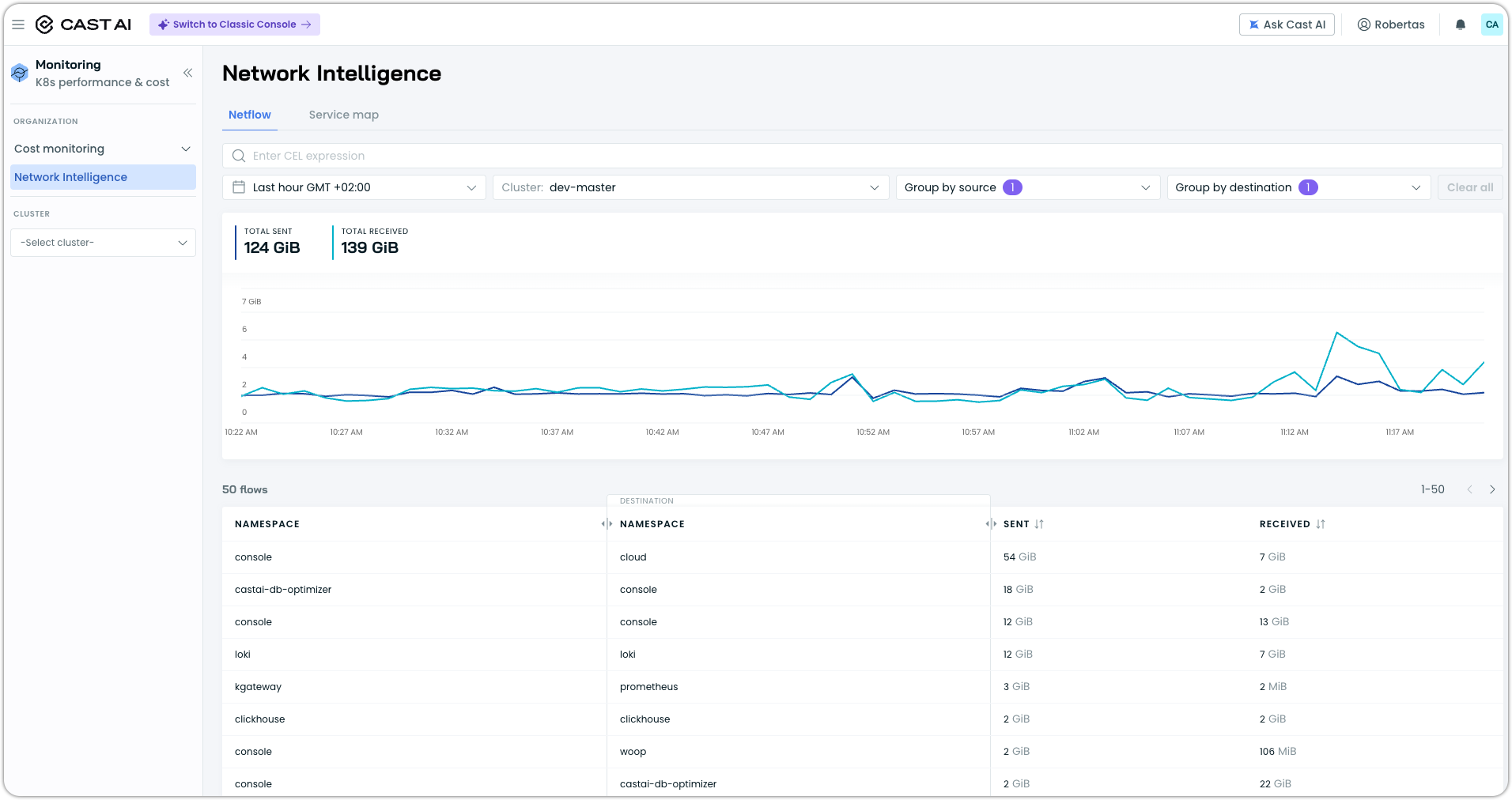
Netflow is a network-related metric that tracks sent and received traffic in bytes. Unlike VPC flow logs, it contains rich Kubernetes context.
In the Netflow list, you can find various Kubernetes cluster network metrics.
The combination of dynamic grouping and advanced CEL-based search makes it easy to find the top cross-zone, cross-namespace, traffic to the Internet, and unexpected spikes.
Search examples
Find cross-zone traffic within the Kubernetes cluster. You can also group sources and destinations by zone only.
zone != "" && dst_zone != "" && zone != dst_zoneFind traffic to the internet.
dst_workload_kind=="internet"Find any traffic from source namespaces.
ns in ["metrics", "kube-system"]Find any traffic from source to destination namespaces.
ns == "metrics" && dst_ns == "kube-system"Find GitLab runners containers that process traffic to the internet. For this search, you can group sources by process only. It can also be helpful to sort by received traffic to see the possible NAT processing impact.
ns == "gitlab" && dst_workload_kind == "internet"Find traffic from the source namespace and pod name prefix.
ns == "gitlab" && pod_name.startsWith("runner-")All available search fields
CEL search can combine multiple available fields for Netflow metadata.
| Property | Type | Description |
|---|---|---|
| protocol | Enum | Available values for the protocol are udp and tcp |
| process | string | Source container Linux process name. |
| container_name | string | Source Kubernetes container name. |
| pod_name | string | Source Kubernetes pod name. |
| ns | string | Source Kubernetes namespace. |
| zone | string | Source node zone. |
| workload_name | string | Source Kubernetes workload name. |
| workload_kind | string | Source Kubernetes workload kind. |
| node_name | string | Source Kubernetes node name. |
| addr | string | Source IP address |
| dst_domain | string | Destination DNS domain. This field is the best effort and may not always be present. |
| dst_pod_name | string | Destination Kubernetes pod name. |
| dst_ns | string | Destination Kubernetes namespace. |
| dst_workload_name | string | Destination Kubernetes workload name |
| dst_workload_kind | string | Destination Kubernetes workload kind or special kinds such as private for any unknown private IPs and internet for any public IP. |
| dst_node_name | string | Destination Kubernetes node name. |
How to enable Netflow collection
The Netflow collection is implemented with Cast AI Kvisor agent and can be installed via the Helm chart.
Which upgrade method to useThe Helm commands on this page use the umbrella chart (
castai-helm/castai) by default. If you need to use a different method:
- castctl: To upgrade all Cast AI components at once without managing Helm flags:
This preserves your existing configuration. See the castctl documentation for installation and authentication instructions.castctl castware upgrade- Individual charts: If you installed each component as a separate Helm release (e.g., for ArgoCD or custom GitOps), replace the release name and chart reference with the component-specific ones (e.g.,
castai-workload-autoscalerandcastai-helm/castai-workload-autoscaler) and remove theautoscaler.castai-workload-autoscaler.value prefix.Not sure which method you used? Run
helm list -n castai-agent. A single release namedcastaimeans umbrella chart; separate releases likecastai-workload-autoscalermean individual charts.
helm upgrade castai castai-helm/castai -n castai-agent --reset-then-reuse-values \
  --set autoscaler.castai-kvisor.castai.apiKey=<your-api-token> \
  --set autoscaler.castai-kvisor.castai.clusterID=<your-cluster-id> \
  --set autoscaler.castai-kvisor.agent.enabled=true \
  --set autoscaler.castai-kvisor.agent.extraArgs.netflow-enabled=true
NoteIf you have
egressdrunning it should be uninstalled.
Updated last month