
Overview
Karpenter Enterprise suite is a suite of optimization features designed to work alongside open-source Karpenter. Rather than replacing Karpenter, Karpenter Enterprise suite extends it with capabilities that help you capture additional savings, improve operational stability, and gain visibility into cluster efficiency.
Why Karpenter Enterprise suite
Open-source Karpenter handles Pod scheduling and Node provisioning effectively. However, organizations running Karpenter at scale often encounter gaps that the open-source project doesn't address:
Cost visibility gaps
Karpenter provisions Nodes based on Pod requirements, but has no awareness of your organization's Reserved Instances, Savings Plans, or negotiated discounts. This can lead to underutilized commitments and missed savings opportunities.
Consolidation limitations
Karpenter's built-in consolidation works at the Node level but doesn't coordinate with workload rightsizing or account for the actual resource utilization patterns of your applications.
Spot reliability concerns
While Karpenter supports Spot Instances, it treats all Spot pools equally and relies on the standard two-minute interruption warning. Teams often limit Spot adoption due to unpredictable interruptions.
Operational overhead
After Spot fallback to On-Demand, clusters can accumulate expensive Nodes that remain in place long after Spot capacity becomes available again. This requires manual intervention to recover cost savings.
Karpenter Enterprise suite addresses these gaps by layering Cast AI's optimization capabilities on top of your existing Karpenter deployment.
How Karpenter Enterprise suite works
Karpenter Enterprise suite uses a non-intrusive approach that preserves your existing Karpenter configuration while adding enterprise capabilities through Cast AI components.
Architecture
When you connect a Karpenter-managed cluster to Cast AI, the platform deploys Castware components alongside your existing Karpenter installation:
- Cast AI Agent collects cluster metrics and workload data
- Cluster Controller coordinates optimization actions with Karpenter
- Kentroller coordinates Cast AI optimization and automation features with Karpenter
- CLM Controller orchestrates zero-downtime container migrations
- Spot Handler manages Spot Instance lifecycle and fallback recovery
- Pod Mutator automates Pod spec adjustments for optimal placement
- Workload Autoscaler handles continuous rightsizing
These components work with Karpenter's existing CRDs and node provisioning logic. Cast AI guides Karpenter's decisions through CRD modifications and policy adjustments rather than replacing its core functionality.
CRD-first approach
Karpenter users expect to manage configuration through Kubernetes Custom Resource Definitions. Karpenter Enterprise suite maintains this pattern—Cast AI modifies Karpenter CRDs to influence provisioning decisions while keeping configuration in the Kubernetes-native format you're already using.
For example, when Cast AI identifies under-utilized Reserved Instances in a specific instance family, it can adjust your NodePool CRDs to prioritize that family for new capacity. Once those commitments are fully utilized, the configuration shifts to prefer the most cost-effective alternatives available.
Concept mapping
If you're familiar with Cast AI's standard Autoscaler, the following table shows how Karpenter concepts map to Cast AI equivalents:
| Karpenter concept | Cast AI equivalent | Role |
|---|---|---|
| NodePool | Node Template | Defines constraints for Node provisioning: instance types, zones, capacity types, taints, and labels |
| EC2NodeClass (AWS) | Node Configuration | Defines cloud-provider-specific settings: AMI, security groups, subnets, etc. |
With Karpenter Enterprise suite, you continue using NodePools and EC2NodeClasses. Cast AI reads and, when optimization features are enabled, modifies these CRDs to steer provisioning decisions—but your existing resources remain the source of truth.
If you later migrate to Cast AI Autoscaler, your NodePools will be replaced by Node Templates, and your EC2NodeClasses will be replaced by Node Configurations. For details, see Migration from Karpenter.
Key capabilities
Savings analysis and reporting
Before you enable any optimization, Cast AI analyzes your Karpenter-managed cluster and generates a savings report showing specific optimization opportunities.
Compare current spending against optimized configurations that use spot instances, right-sized nodes, and commitment-based pricing where applicable.
Review how efficiently workloads are packed onto nodes and identify opportunities to reduce waste from underutilized capacity.
See how well Reserved Instances and Savings Plans are being used, and where gaps exist that could be filled with on-demand or spot instances.
Planned for a future release.
Identify pods with resource requests that don't match actual usage patterns, allowing you to adjust requests and reduce node footprint.
This report shows the difference between what Karpenter delivers and what additional optimization is possible with Cast AI. You can use the free reporting tier indefinitely without enabling active optimization.
Continuous rebalancing
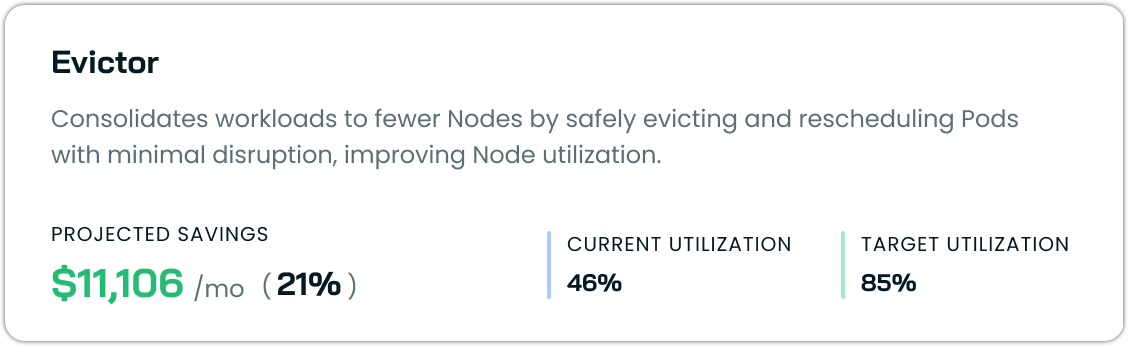
Kentroller's Continuous Rebalancing monitors your cluster on a recurring cycle and consolidates underutilized nodes. When enabled, it takes over consolidation from Karpenter entirely — Karpenter continues handling drift detection, but cost-driven consolidation runs exclusively through Kentroller. Unlike standard eviction, this integration:
- Coordinates with Workload Autoscaler to account for actual resource usage, including pending rightsizing recommendations not yet applied to Pods
- Uses Container Live Migration (when available) to move workloads without restarts
- Runs only when projected savings meet configured thresholds, avoiding unnecessary churn
- Offers fine-grained control over what gets consolidated and how — including per-Pod and per-Node eviction policies, configurable modes, and node exclusions — going well beyond what Karpenter's native consolidation exposes
The result is tighter bin-packing with reduced disruption to running applications.
Cluster rebalancing
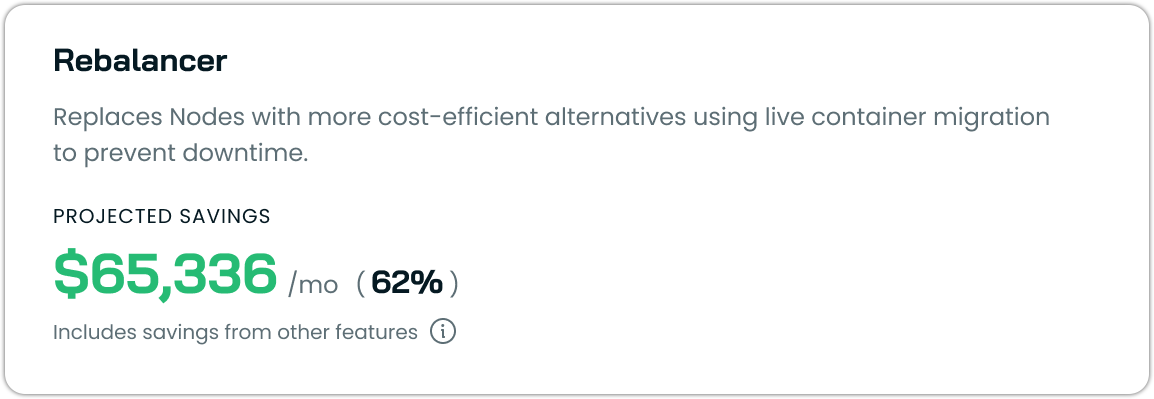
While Karpenter optimizes at the Node level, Cast AI's Rebalancer operates across the entire cluster to identify optimization opportunities that span multiple NodePools:
- Identifies Nodes that could be replaced with more cost-effective alternatives
- Coordinates replacements to maintain workload stability
- Accounts for constraints like availability zones, architecture requirements, and capacity types
- Avoids recently failing instance type, zone, and capacity type combinations based on observed capacity failures
- Works alongside Karpenter's provisioning rather than competing with it
Spot intelligence
Cast AI enhances Karpenter's Spot Instance handling with prediction, reporting, and reliability capabilities:
Interruption prediction
Cast AI's prediction model identifies at-risk Nodes up to 30 minutes before interruptions occur—extending AWS's standard two-minute warning significantly. This additional lead time enables graceful workload migration with minimal disruption.
Observed interruptions
Kentroller reports observed Spot interruptions in Karpenter-backed clusters. Cast AI uses these observations with other capacity data to improve Spot capacity intelligence.
Spot reliability model (coming in future releases)
Cast AI maintains global telemetry across connected clusters to identify which Spot pools have historically stable capacity. By steering Karpenter toward reliable pools, interruptions can be reduced substantially compared to random pool selection.
Spot fallback recovery
Spot fallback recovery is planned for a future release. Currently, if Karpenter falls back to On-Demand due to Spot unavailability, those Nodes remain On-Demand until manually replaced or consolidated.
When Spot capacity is unavailable, Karpenter falls back to On-Demand instances. The problem is that these fallback Nodes often remain in place long after Spot capacity returns, accumulating unnecessary costs.
Cast AI's Spot Handler monitors market conditions and automatically recovers Spot capacity when it becomes available. This bidirectional fallback ensures clusters don't get stuck on expensive On-Demand Nodes.
Workload rightsizing
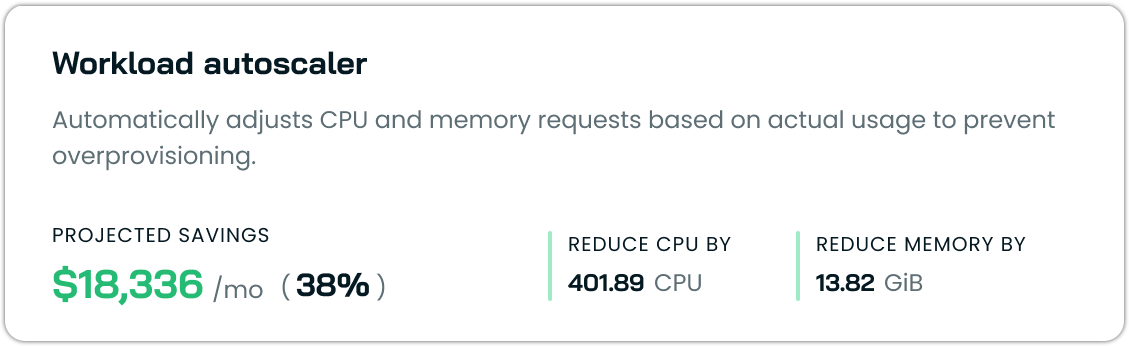
Most Kubernetes workloads are over-provisioned. Requests are set conservatively, leaving clusters with significant waste that Karpenter can't address because it provisions based on what Pods request, not what they actually use.
Workload Autoscaler continuously learns actual resource utilization and adjusts requests to match reality. This tighter fit enables better bin-packing and reduces the total compute capacity your cluster requires.
Workload Autoscaler integrates with Continuous Rebalancing and Rebalancer so that rightsizing decisions flow through to Node-level optimization automatically.
Pod mutations
For teams onboarding existing clusters to Cast AI, Pod mutations automate the configuration changes needed to take advantage of optimization features. Rather than updating every Deployment manifest, you define mutation rules that automatically apply labels, tolerations, and NodeSelectors to matching Pods.
For teams that have already onboarded and seek to take advantage of Spot Instances, Pod mutations allow for proportionally distributing Pods across On-Demand and Spot Instances automatically based on assigned labels.
What Karpenter Enterprise suite doesn't change
Karpenter Enterprise suite is designed to be non-intrusive:
- Your NodePools remain yours – Cast AI works with your existing NodePool definitions
- Karpenter continues provisioning – Node creation and deletion flow through Karpenter
- Rollback is straightforward – Removing Cast AI components returns your cluster to its original Karpenter-only state
- No vendor lock-in – Your Karpenter configuration remains portable
Unsupported configurations
Running Cast AI Autoscaler alongside Karpenter
Karpenter Enterprise suite is designed for clusters where Karpenter is the sole node provisioner. Running Cast AI's standard node autoscaler and Karpenter together in the same cluster is not supported and will result in undefined behavior.
Switch from Karpenter Enterprise suite to Cast AI Autoscaler
If you onboarded your cluster with the Karpenter option and want to use the standard Cast AI Autoscaler instead, you must off-board the cluster from Cast AI and re-onboard it as a standard EKS cluster.
To switch:
-
Off-board the cluster from Cast AI by deleting the
castai-agentnamespace. This removes all Cast AI components from the cluster:kubectl delete namespace castai-agent -
Uninstall Karpenter from the cluster if you no longer want to use it as your node provisioner. Refer to the Karpenter documentation for removal steps.
-
Re-onboard the cluster in the Cast AI console. Click Connect cluster, select EKS as your provider, and choose Other (not Karpenter) as your autoscaling tool. Run the generated onboarding script.
The re-onboarded cluster will have access to use Cast AI Node Autoscaler.
The off-boarding step removes Cast AI components only. Your nodes, pods, and Kubernetes configuration remain intact throughout the process.
Next steps
Ready to see what optimization is available for your Karpenter cluster?
Get started with Karpenter Enterprise suite – Connect your cluster and view your optimization potential
Related resources
- Karpenter Enterprise suite features – Feature details and Karpenter integration
Updated last month